 1200
627
1200
627
Self-Ties, Pot Pointers, Bed Cards and Swing Tags: A Guide to Horticultural Label Formats
Written by
Matt Lawson
OKI shop, The OKI Pro Series printer experts 310
310
310
310
Read it in 6 minutes
Walk a garden centre in spring and you will pass five or six different label formats before you reach the till. Most of them are doing a job no other format could do as well.
If you are looking at printing your own plant labels, the format question comes before the printer question. What you print determines the media you buy, and the media determines what the machine needs to handle.
This guide covers each of the main formats, what it is for, and where it works better than the alternatives.
What are the main horticultural label formats?
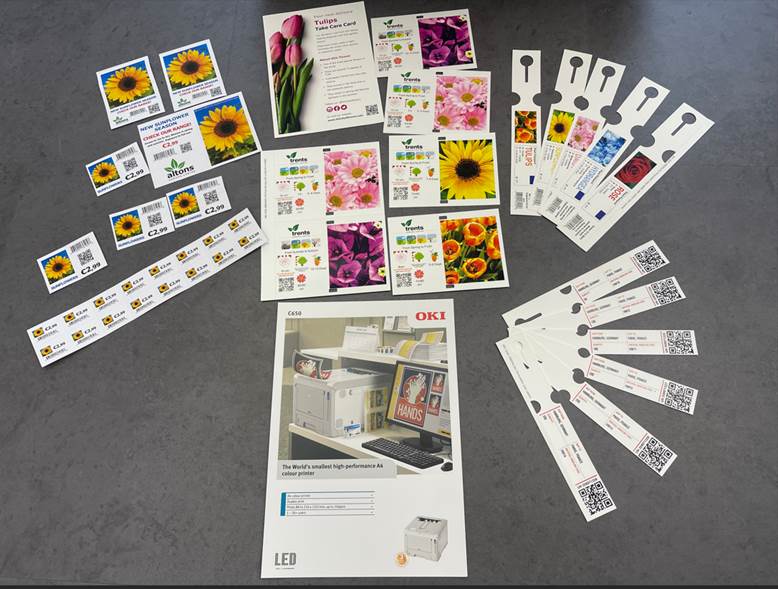
There are five in common use: self-ties, pot pointers, self-adhesive labels, swing tags and bed cards.
They differ in how they attach to the plant or the display, not in how they are printed. One machine will produce all five, provided it handles the media each one needs.
| Format | Best for | Usual media |
|---|---|---|
| Self-tie or loop lock | Shrubs, trees, climbers and anything with a stem or branch to attach to | Synthetic, for outdoor life |
| Pot pointer or stick-in | Potted stock, trays and plugs, where there is compost to push into | Synthetic, rigid enough to insert |
| Self-adhesive label | Pots, trays and containers with a clean flat surface | Weatherproof self-adhesive |
| Swing tag | Gift lines, bare-root stock, tools and anything sold with a price ticket | Coated card, or synthetic outdoors |
| Bed card | Bench and bed identification at eye level, and grouped displays | Heavy card, laminated or synthetic |
What is a self-tie label?
A self-tie is a long, narrow label with a keyhole slot at one end. It loops around a stem or branch, threads through the slot and locks against itself, so no ties, staples or adhesive are needed.
They are also sold as loop locks or tie wraps, and they are the standard choice for shrubs, trees, roses and climbers. Because they hang loose rather than sitting flat, they stay legible as the plant grows and they survive being handled on the bench.
Self-ties spend their whole life outdoors, so they are usually printed on weatherproof synthetic stock rather than card.
What is a pot pointer or stick-in label?
A pot pointer is a rigid label with a pointed foot that pushes into the compost and stands upright in the pot. Stick-in and push-in are the same thing under different names.
They suit potted stock, trays and plugs, where there is no stem to attach to and a customer needs to read the label without picking the pot up. The trade-off is that they can be pulled out and put back in the wrong pot, which is a real cost in a busy garden centre.
The material has to be stiff enough to push into compost without buckling, which rules out most paper stock.
What are swing tags used for?
A swing tag is a printed card or synthetic tag with a punched hole, attached with string, elastic or a plastic fastener. In horticulture it does the jobs a self-tie cannot.
Typical uses are gift lines and gift plants, bare-root and container stock sold with a price ticket, tools and sundries, and anything where the tag carries branding as much as information. Swing tag printing is also where garden centres with their own brand tend to start, because the tag is the most visible piece of print on the product.
Tags going outdoors need synthetic stock. Tags on indoor gift lines can sit on coated card, which takes colour better and costs less.
What is a bed card?
A bed card is a larger card or sign that identifies a bench, bed or grouped display rather than an individual plant. It sits at eye level and carries the name, the price and often a photograph of the plant in flower.
Bed cards earn their place because they do the selling that a small label cannot. A customer looking at a bench of dormant perennials in March is buying from the picture on the bed card, not from the plant in front of them.
Bed cards overlap with promotional signage and seasonal point of sale, which is where the same machine starts paying for itself twice.
What about self-adhesive pot labels?
Self-adhesive labels apply directly to the pot, tray or container. They are the neatest option where the surface is clean, flat and dry, and they cannot be swapped between pots by customers.
They are less forgiving than the alternatives. A cold, wet or dusty pot will not hold an adhesive label reliably, and textured or heavily ribbed pots are difficult surfaces. For growers labelling at potting-up stage, in controlled conditions, they work well.
Which format should you use?
Start from how the label attaches, not from what it costs:
- If there is a stem or branch, use a self-tie.
- If there is compost and no stem, use a pot pointer.
- If the container has a clean flat surface and labelling happens indoors, use a self-adhesive label.
- If the item is sold as a gift or carries your brand, use a swing tag.
- If you are identifying a group rather than an individual plant, use a bed card.
Most garden centres end up running three or four of these at once, which is exactly why buying pre-printed labels for each format becomes awkward. Every format is a separate order, a separate minimum quantity and a separate lead time.
What information should go on a plant label?
At minimum: the common name, the botanical name, and a price or barcode if the label is customer-facing.
Beyond that, what sells the plant is care information. Position and aspect, eventual height and spread, hardiness, flowering period and watering needs are the details a customer reads before deciding. A photograph of the plant in flower matters most on stock that looks unremarkable at the point of sale.
Printing in-house means this content is not fixed at the point of ordering. If a price changes or a description is wrong, you reprint that label rather than living with it for the rest of the season.
Can one printer produce all of these?
Yes, provided it handles the media. An A3 colour printer built for graphic-arts work will take synthetic label stock, rigid pot pointers, coated tag card and heavier bed card material through the same machine.
What matters is the weight and thickness range the printer accepts, and whether it has a straight-through paper path for rigid media. OKI Pro Series machines are built for this kind of work rather than for office paper.
If your range includes kraft, coloured or clear stock, the Pro9541dn adds a fifth station for spot white, which four-colour machines cannot reproduce. Running costs come down to the toner and the media rather than to per-order minimums.
Where does this leave you?
Work out which formats you actually use across a full season, including the ones you currently go without because the minimum order is too high. That list is the specification.
We supply OKI Pro Series label printers to garden centres, nurseries and growers across the UK. Call us on 01903 692222 or talk it through with us before you commit to a machine, and we will tell you what your format list actually needs.
You can also read more about horticultural labelling and what a garden centre can produce on site.